


07-10-2011, 06:49 PM
About 17 million years ago, the tectonic regime of western North America changed. Before that time, the tectonic plate underneath the Pacific Ocean was subducting beneath North American plate, creating a compressive regime that resulted in high mountain ranges and plateaus along the west coast of North America. Beginning around 17 million years ago, the plate boundary changed and the Pacific and North American plates began sliding past one another between what is now Southern California and San Francisco. No longer in compression, this change in the stress regime allowed the high terrain of western North America to collapse and extend westward. This regime continues today, as the plates are sliding past one another, splitting California in half, and creating the San Andreas fault system.
The extension created an interesting topography in southern and western Arizona, Western Utah, Eastern California, and all of Nevada. As the crust of Western North America was no longer being shortened and pushed upward from compression, it began breaking apart along faults, with narrow basins and valleys dropping between high mountain ranges. The result is topography of tremendous relief, with great differences between the elevations of the mountain peaks and the valley floors. This topography is extremely apparent today as a series of parallel and alternating valley/mountain sequences that trend from northwest to southeast. Death Valley is an extreme example of one of those valley/mountain sequences.
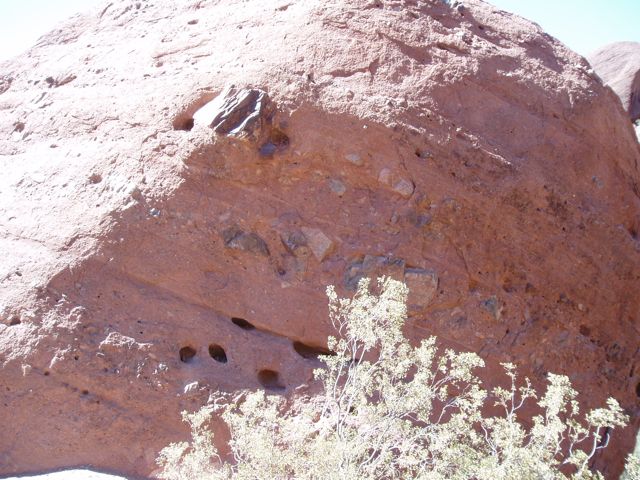
As the basins subsided relative to the steepening mountain ranges, course gravel and sand sediment from the mountains filled the basins. As the coarse sediment became cemented with calcium carbonate, it solidified into thick rock masses called "conglomerate". Eventually, river and stream networks matured and linked the basins, causing erosion and exposing the conglomerate near the basin edges.
Examples of such conglomerate exist in nearly every valley of southwestern Arizona, Eastern California, Nevada, and western Utah. An example of this conglomerate forms the “head” of Camelback Mountain in Phoenix, and is appropriately named the “Camel’s head Formation”
So what does this mean to my layout? Copper ores and mines, such as the one on my layout, are located in the hard rock areas of the mountain ranges. My fictional railroad traverses from the valley into the mining district within the mountains. That means I need to model the conglomerate as well as the hard rock of the mountains. I already made the hard rock using plaster and rock molds, and I'm somewhat satisfied with the results. Modeling the conglomerate, on the other hand, was causing some anxiety.
I eventually found a technique that I am satisfied with. The overall appearance of the conglomerate in my modeling area is of relatively flat-lying sediment beds. Coarse gravel pieces support some sediment beds, while others are mostly sand. Some beds are well-cemented and resistant to erosion, while other beds are poorly cemented and crumble more easily. This leaves an alternating appearance with stronger beds forming steep ledges and weaker beds forming recessed layers within the steep vertical profile, or gentle slopes where the weaker bed is thick.
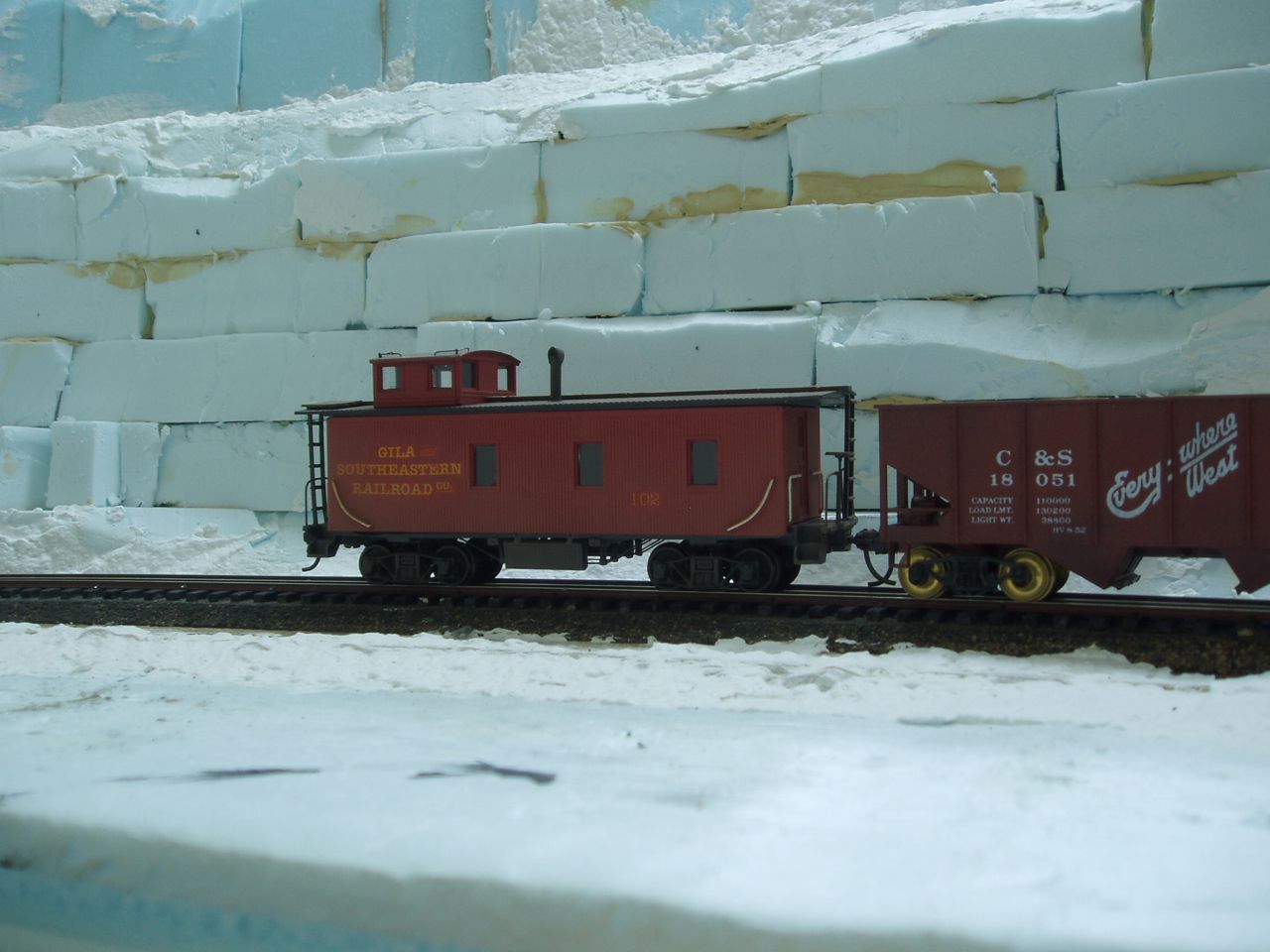
Because of the layered appearance of the rock, I started with stacked 1-inch blue foam. Rather than make long, continuous layers of foam, I cut the foam into smaller blocks and glued them in place separately. This created a more random appearance than if I had used large pieces of foam.
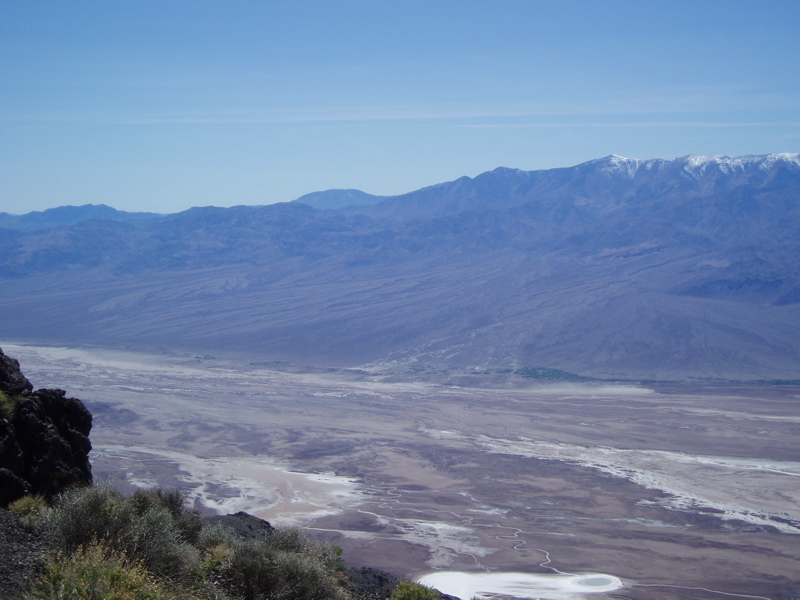
The extension created an interesting topography in southern and western Arizona, Western Utah, Eastern California, and all of Nevada. As the crust of Western North America was no longer being shortened and pushed upward from compression, it began breaking apart along faults, with narrow basins and valleys dropping between high mountain ranges. The result is topography of tremendous relief, with great differences between the elevations of the mountain peaks and the valley floors. This topography is extremely apparent today as a series of parallel and alternating valley/mountain sequences that trend from northwest to southeast. Death Valley is an extreme example of one of those valley/mountain sequences.
As the basins subsided relative to the steepening mountain ranges, course gravel and sand sediment from the mountains filled the basins. As the coarse sediment became cemented with calcium carbonate, it solidified into thick rock masses called "conglomerate". Eventually, river and stream networks matured and linked the basins, causing erosion and exposing the conglomerate near the basin edges.
Examples of such conglomerate exist in nearly every valley of southwestern Arizona, Eastern California, Nevada, and western Utah. An example of this conglomerate forms the “head” of Camelback Mountain in Phoenix, and is appropriately named the “Camel’s head Formation”
So what does this mean to my layout? Copper ores and mines, such as the one on my layout, are located in the hard rock areas of the mountain ranges. My fictional railroad traverses from the valley into the mining district within the mountains. That means I need to model the conglomerate as well as the hard rock of the mountains. I already made the hard rock using plaster and rock molds, and I'm somewhat satisfied with the results. Modeling the conglomerate, on the other hand, was causing some anxiety.
I eventually found a technique that I am satisfied with. The overall appearance of the conglomerate in my modeling area is of relatively flat-lying sediment beds. Coarse gravel pieces support some sediment beds, while others are mostly sand. Some beds are well-cemented and resistant to erosion, while other beds are poorly cemented and crumble more easily. This leaves an alternating appearance with stronger beds forming steep ledges and weaker beds forming recessed layers within the steep vertical profile, or gentle slopes where the weaker bed is thick.
Because of the layered appearance of the rock, I started with stacked 1-inch blue foam. Rather than make long, continuous layers of foam, I cut the foam into smaller blocks and glued them in place separately. This created a more random appearance than if I had used large pieces of foam.
--
Kevin
Check out my Shapeways creations!
3-d printed items in HO/HOn3 and more!
<!-- m --><a class="postlink" href="https://www.shapeways.com/shops/kevin-s-model-train-detail-parts">https://www.shapeways.com/shops/kevin-s ... tail-parts</a><!-- m -->
Kevin
Check out my Shapeways creations!
3-d printed items in HO/HOn3 and more!
<!-- m --><a class="postlink" href="https://www.shapeways.com/shops/kevin-s-model-train-detail-parts">https://www.shapeways.com/shops/kevin-s ... tail-parts</a><!-- m -->